
Why Fruit Ripens
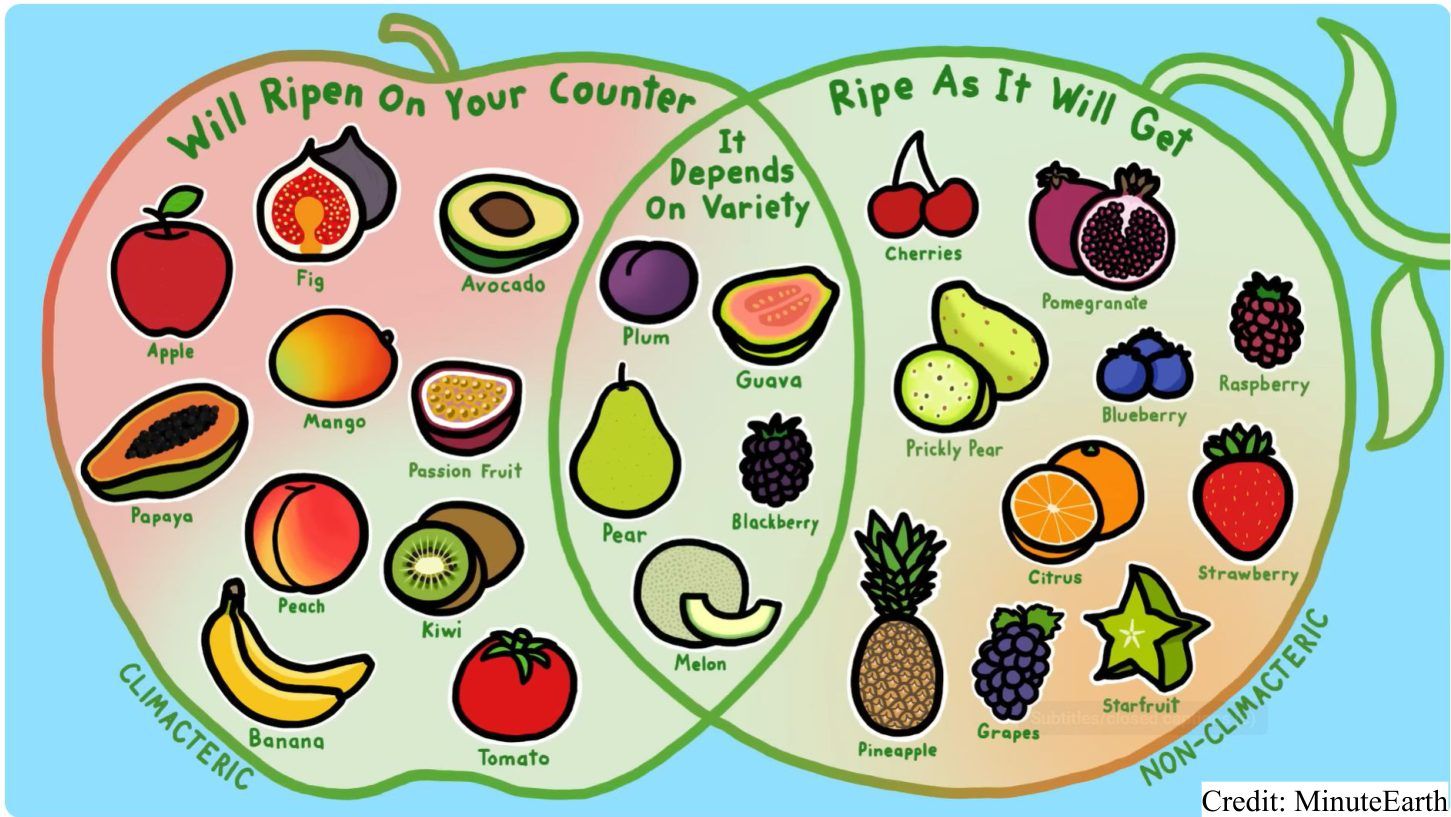
A chart showing which fruits ripen on the tree/plant and which fruits ripen after they’re picked;
Photo: Credit: MinuteEarth
As I have observed, everyone does the following: they buy a pineapple, watermelon, or pomegranate and leave it to ripen in the fridge or on the counter. After a few days, up to a week, these fruits don’t ripen, instead, they rot. Why do some fruits ripen after picking, and some, like those, don’t? Let’s first see why fruits even have the ripening process in the first place.
To see why fruits ripen, we need to understand why plants bear fruits. According to Minuteearth (which I recommend people watch), the reason that most plants go through all the hassle to fruit is that they need a way to spread their seeds. Plants that don’t have the fruit we know have seeds that disperse by the wind, water, etc, but fruiting plants use a different way of spreading: animals. Here’s what happens: Let’s say we have a cherry tree. A bird comes along and eats a cherry. The cherry makes its way through the digestive system of the bird, and over all that time, the bird travels far away from the cherry tree and poops the seed out. This way, the seed can go miles away from its original tree and can grow without the other tree competing for resources.
Now, what does this have to do with fruits that ripen on your counter? Well, depending on the type of fruit, and the animals that spread it, there are different reasons why the fruit ripens away from the plant, or not. Let’s take our previous example, the cherry. Let’s imagine that same cherry, about to be eaten by the bird. Most fruits ripen where the animals that eat them hang out. The cherry only ripens on the tree, which is where the birds eat them. It also is because of the substance ethylene, which is an important part of the climacteric and non-climacteric (cordless and non-cordless) fruits. Climacteric fruits keep ripening after they’re removed from the plant, while non-climacteric fruits don’t. For climacteric fruits, ethylene is produced by the plant itself and can be absorbed by neighboring cordless fruits.
The ripening process also affects whether it ripens on or off the tree. One reason fruits ripen slowly is because they don’t want the animals spreading the seeds too early because the seeds that are undeveloped die. So the plants, to protect their seeds, grow a thick layer of skin that blends in with their surroundings and protects them from animals. They also produce bitter compounds to ward off animals. But when the seed is mature, it changes course. It thins its skin and develops an aroma that attracts animals. The fruit becomes sweet and shows its bright attractive colors. Some fruits need to be able to ripen on the ground, like bananas that often fall from their trees too early. Others, like the previously observed cherry, do not need to ripen on the ground, so they didn’t evolve the ability to do so.
Here are some fruits that have been classified by Minuteearth showing which fruits ripen off the tree or on the tree (see the diagram on the bottom left).
Climacteric (Cordless) – Ripen off the tree
● Apple ● Banana ● Fig ● Avocado (Yes, it is a fruit) ● Mango ● Passion Fruit ● Papaya ● Peach ● Kiwi ● Tomato (Also a fruit)
Non-climacteric (Non-cordless) – Ripen on the tree
● Cherry ● Pomegranate ● Prickly Pear (The cactus fruit) ● Most berries
● Citruses (Oranges, Lemons etc) ● Grapes ● Pineapple ● Star fruit
It depends on the species
● Melons ● Blackberry ● Plum ● Guava ● Pear