Rethink Your Drink
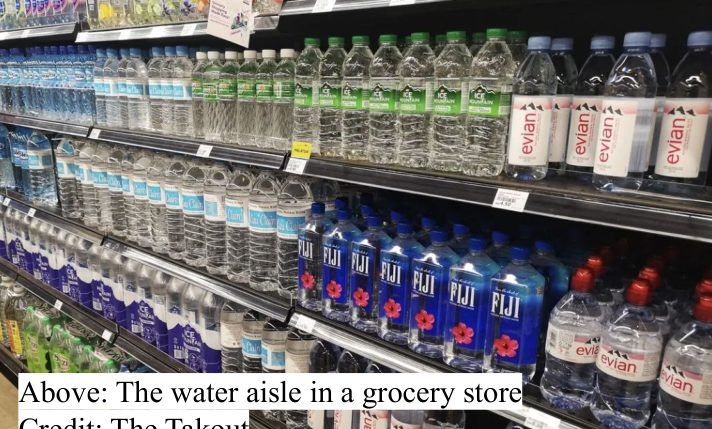
Above: The water aisle in a grocery store
Photo: Credit: The Takout
Water is everywhere. We use it for drinking, personal hygiene, cleaning, and more. There are more water brands than anyone can count. Is there any difference between all of them? The answer is yes. While different water brands may taste the same, there are different health benefits due to added minerals and where the water is from. According to Healthline, there are nine different types of water: tap water, mineral water, spring/glacier water, sparkling water, distilled water, purified water, flavored/infused water, alkaline water, and well water. I will focus on popular water brands of each type except tap, well, purified, and distilled water.
Mineral Water
Fiji
Mineral water is water with lots of minerals. Minerals can be obtained in a mineral spring or added to water artificially. The water brand Fiji sells mineral water. It starts as rainwater and then flows on volcanic rock into an aquifer. Fiji water is rich in the mineral Silica, which is great for your hair, bones, and nails.
Spring Water
Evian
Spring water, like some varieties of mineral water, comes from springs. The spring filters the water so it is naturally clean. A great example of bottled spring water is the brand Evian. This water has an incredible two-century history in Évian-les-Bains, a French town. The company started as a spa around the water source and then in 1826 they started bottling the water. Evian is full of minerals so it can be classified as mineral-spring water. It is described to taste very mineral-heavy, and either smooth or slimy.
Glacier Water
Svalbarði
If glacier water touches the ground, it is mineral-rich but may contain bacteria. Svalbarði Water, a costly water brand, uses water from the part of a glacier that does not touch the ground and has no minerals. Priced at €95 per 750 ml bottle (about $105), the water has an incredibly pure taste and smooth texture due to the low mineral levels. Svalbarði Water ran out of business in 2020 because the glaciers they were using were melting alarmingly fast.
Sparkling Water
San Pellegrino
Sparkling water contains carbon dioxide, which causes fizziness in the water. Sparkling water can have flavoring (ex. soda) or be carbonated water. An example of sparkling water is San Pelligrino. This brand is very popular in upscale restaurants and hotels because of the fancy packaging and uniqueness of the product.
Flavored/Infused Water
Hint
Flavored and infused waters have added flavors. These flavors can be obtained naturally (ex. adding a slice of watermelon in a water pitcher) or artificially (ex. using sweeteners and sugar). This type of water is popular because many fun flavors make drinking water interesting. A bad thing about this type of water is when it uses artificial flavoring, it is bad for your health. An example of naturally flavored water is the brand Hint. This brand has many flavors, including watermelon, blackberry, pineapple, and grape. Hint water tastes like water with a hint of fruit.
Alkaline Water
Essentia
Alkaline water has a higher pH level than most water. A pH level is acidity, 7 being neutral, less than seven being acidic, and more than 7 being alkaline. Alkaline water is rumored to slow your aging and even prevent cancer, but these theories are not scientifically proven. Alkaline water may be bad because it might lower your stomach acids. A good example of bottled alkaline water is the brand Essentia. Essentia water is described as tasting clean with no aftertaste. Essentia water is 99.9% pure water, which causes this fresh taste.
This article just scratches the surface of the vast world of bottled water. If you walk into any grocery store, convenience store, or gas station, you are sure to find 5+ different types of water. There are many arguments for what type of water is the best, and health is only one of the many factors including carbon footprint, availability, price, and packaging. There is no “best water”, only the water that works best for you.