Interview with Poet and Essayist Aimee Nezhukumatathil
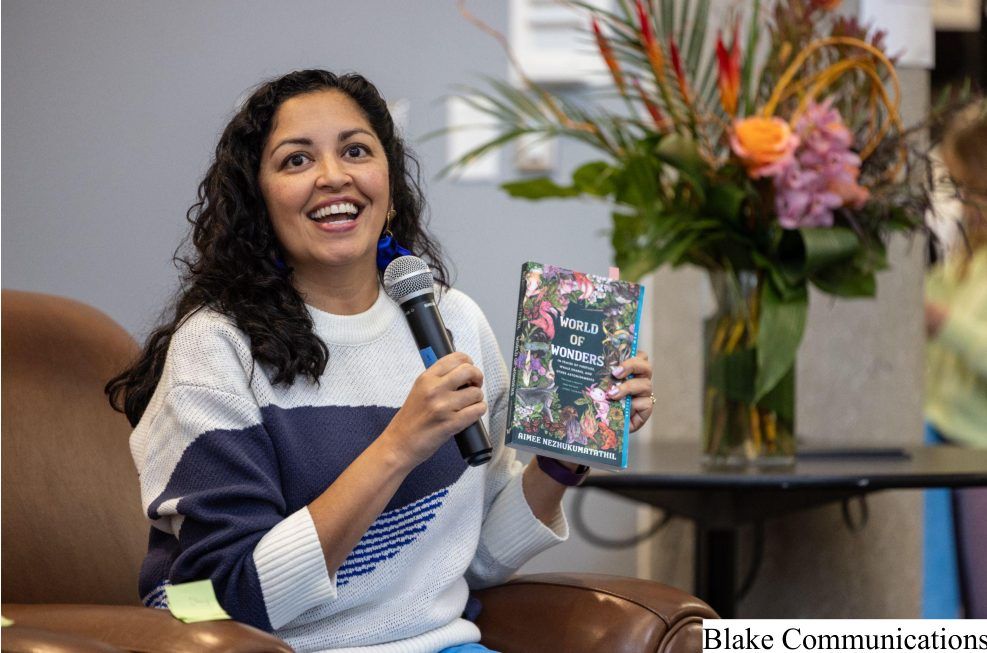
Aimee Nezhukumatathil at the Wonderfair event at Blake
Photo: Blake Communications
Recently, Aimee Nezhukumatathil had a residency at Blake through the Philip Otis Environmental Author Program. Aimee has written many books, including World of Wonders, which she came to Blake to talk about. While here, Aimee did a variety of workshops and presentations.
Gabriel Shen: What is your connection to nature?
Aimee Nezhukumatathil: I think we're all connected to nature. And I think some of us stay in tune and in touch with nature. And some kind of forget, or don't try to emphasize that part of our lives. For me, it was the one place where people didn't ask me questions about, “Where am I from?” Or the dreaded, “What are you?” question. The trees never asked me annoying questions like that. So I was just happy to be outside all the time.
How did you transition from poetry to essays?
My graduate degree is actually in poetry and essays. I just had earlier success with poetry. I knew I wanted it to be bigger than a poem, but my essays are still short. So it wasn't a hard transition. It was more of just concentrated focus.
I just had no interest in doing a book of lectures. I wrote it originally for my sons who were six and nine. And when I was revising it, I didn't have scientists in mind, I had my best friends in mind.
What inspires you or motivates you to write?
Growing up, I saw no books that featured anybody that even remotely looked like me, and most of the nature books I read were all by men. I thought that was so strange because I grew up with a really great mom who was outside all the time. And, when I was in Chicago, I would see people of all different backgrounds. But what motivates me is to get nature books that are written by authors with a variety of backgrounds.
I also think of all of my books as one big love poem to the earth but also to my family.
How do you connect the natural wonders to your own life?
80% of [the essays] I thought of the [moment first]. I was collecting moments from my childhood and teenage years, and into grown-ups’ time. And then I was pondering what animal reminds me of the scene or the situation. About 20% of the time I had an animal that I really wanted to tackle. And then I was like, what can I use for my life in here? Some of them, I did not make a connection like the Cassowary.
The last chapter of your book seems to show that you think kids should be spending more time in nature. What is your message to the kids and students at Blake?
In the last 20 years, I've seen an absolute decrease in student knowledge of the outdoors. Fewer students know how to even climb a tree because they're just not outside. And when I asked them, like, what are you doing in the summer? The number one answer is video games. Number two is like movies or whatever, but they're on their phones.
So whatever you can do to be outside and away from screens, not banning the screens, but just to remember what it's like to be curious about outside.
What natural wonder do you think describes your current stage of life?
Nobody has asked me that question ever, ever in 20 years. [...] I’ll go with a painted bunting.
It's red, blue, and yellow altogether. [I haven’t seen one yet], but that will be my number one dream bird.
Although, the one that's the most colorful is the male. The painted [bunting] is unafraid and doesn't apologize for who they are. They're just so audacious. It's the most colorful of all the backyard birds. And it's not shy about it. I love their vibe, as my boys would call it.
The other thing I would say is the female Blanket octopus. That's one of the only animals where the female is more colorful than the male. So maybe the better answer is the octopus. Once you look at both of them, you'll see why it's impossible for me to choose just one.
Do people ever pronounce your last name wrong?
My whole life that has happened. Actually, Blake has been incredible. Everyone from kindergarteners to administration has said my name correctly. It bothers me less now, but it used to really bother me when people wouldn't even try. Or they would make a joke about it before I would come on stage.
That's the stuff that's kind of annoying and heartbreaking. Like, wow, you don't know how to say it so you're gonna just make fun.
Those are all my questions. Do you have any other things you would like to add?
I've just been so impressed with the faculty and students. Curiosity here at Blake, and it's truly like I can tell I don't have to teach anybody here how to have wonder. It's something that's part of the fabric of the school already.
This is a shortened version of the interview. For the entire transcript, either scan this QR code or go to bit.ly/InterviewBBB.