
Four Types of Engagement
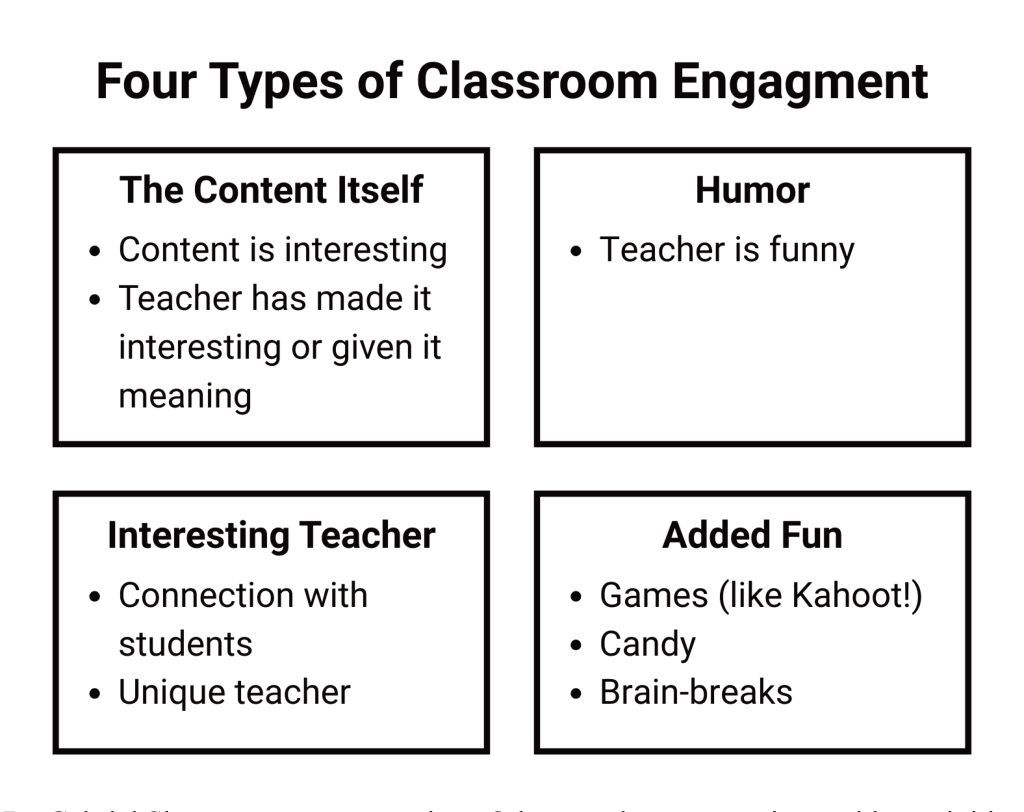
Four Types of Classroom Engagment: The Content Itself (content is interesting; teacher has made it interesting or given it meaning), Humor (teacher is funny), Interesting Teacher (connection with students; unique teacher), Added Fun (games like Kahoot!, candy, brain-breaks)
Photo:
You might think certain classes are destined to be boring. And that others are destined to be fun. But, in reality, there is a very specific formula to how engaging a class is. I came up with four basic categories for engagement.
The Content Itself
Sometimes, the topic the teacher is teaching is interesting. Or they’ve made it interesting with the way they’re teaching it. This type of engagement happens in certain classes where the material is very engaging. For example, a class like P.E. is engaging on its own - it doesn’t need much else to hold students attention. This engagement also occurs when a teacher has made the content interesting, either in the way they are teaching it or giving it meaning, or by enhancing it with projects, activities, or other material related to the topic. For this type of engagment, it’s vital to have a balance between challenging students and letting them succeed.
Humor
One of the best ways to hold students’ attention is to be funny. Humor makes a class fun. Unlike the other categories, humor is hard to explain. Certain teachers have it, and it makes their classes engaging. Other teachers aren’t as funny, and they make their classes engaging in other ways. But it’s important to understand that humor can turn a boring class into an amazing one.
Interesting Teacher
Students pay attention more when the person speaking is interesting. It doesn’t matter what they’re saying, just that they are interesting as a person. If Taylor Swift was teaching a class, every student would pay attention, even if she was speaking in a language no one understood. Although most teachers aren’t Taylor Swift, many are quite interesting, which causes students to listen. This is also why students are more likely to listen to a presentation their peers are giving - students know their peers and find them interesting. This type of engagement focuses more on the relationship between the teacher and the student.
Added Fun
Oftentimes teachers will make classes fun or interesting with activities and items unrelated to the course itself. These attention-grabbers draw students attention so they will focus more. There are countless examples of these: candy, online learning games (Kahoot, Gimkit, etc.), challenges, and games like “silent-ball.” Many teachers call these brain-breaks, when students can regain their attention with something fun.
Few classes have all four types of engagement. Few classes only have one type. Most are a mixture of more than one, allowing for a unique blend. After thinking about the classes you find boring, you will likely find that they score low in all of the categories. Engagement is a unique thing - and teachers are experimenting with the best way to achieve it. These four categories are broad, and there are likely many other types. One of these is forced engagement, for example, “I need to pay attention so I don’t fail the test.”
To measure the engagment level of a class, rate each category on a scale from one to five (it’s fine to go over if a certain category is extremely prominent). Add up the total, and you get the engagment level of that class. The 4 to 7 range likely means students are bored. The 9 to 13 range is an ideal engagment level, although sometimes hard to achieve.