
2023 is Hottest Year in 125,000 Years - The Effects Of Climate Change
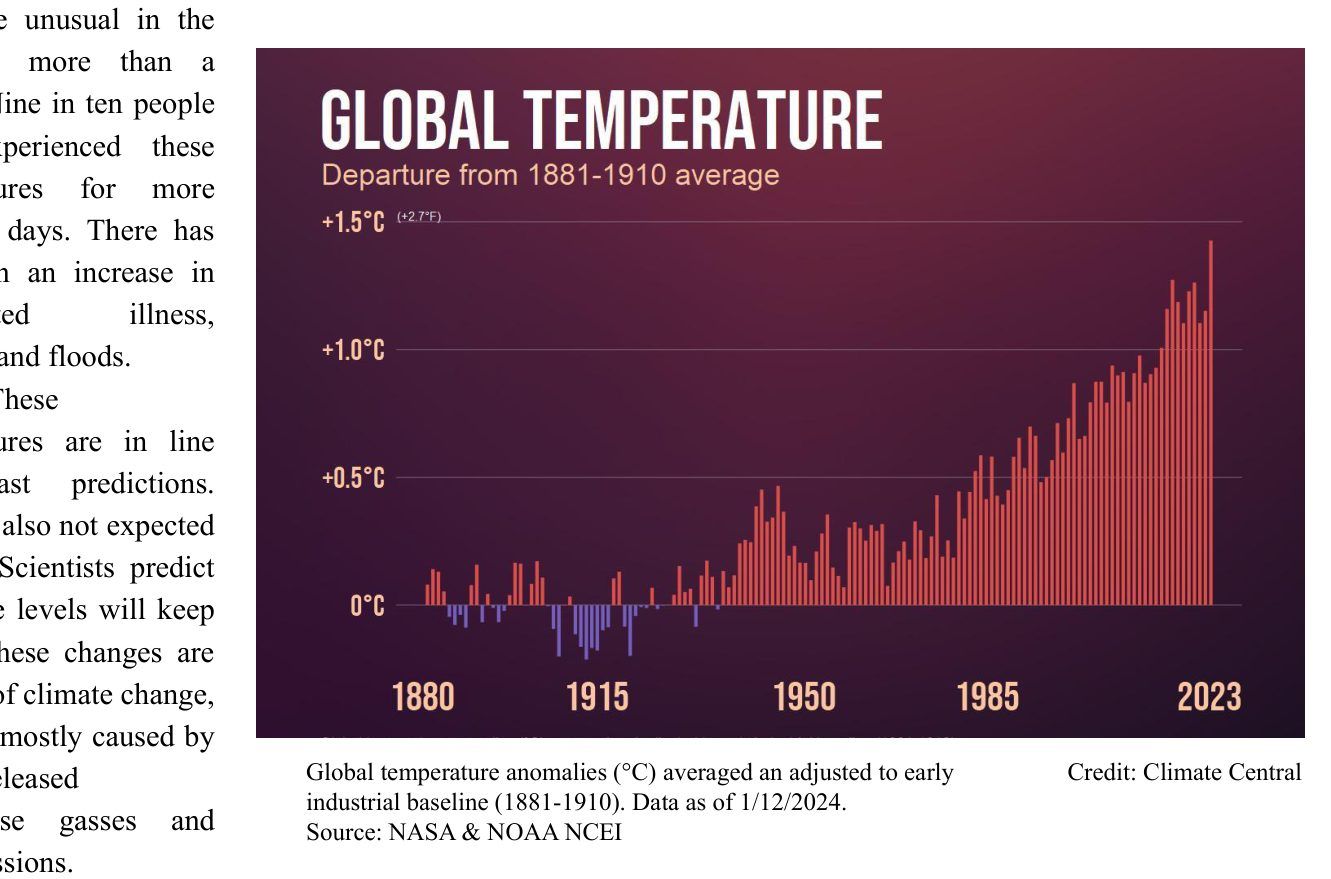
Global temperature anomalies (°C) averaged an adjusted to early industrial baseline (1881-1910). Data as of 1/12/2024. Source: NASA & NOAA NCEI
Photo: Credit: Climate Central
According to an analysis conducted by scientists at Climate Central, a non-partisan, not-profit group of scientists and communicators who research and report about climate change, 2023 has been the hottest year in the past 125,000 years. This means that the earth’s average temperature is reaching a benchmark that scientists have predicted could destroy its ecosystems, 1.5 degrees Celsius, or 2.7 degrees Fahrenheit higher than pre-industrial temperatures. Over a dozen countries have met or passed this benchmark: Romania, Bulgaria, Bosnia, Moldova, Morocco, Austria, Hungary, Montenegro, Algeria, and Ukraine, the study said. The average temperature in two countries, Switzerland and South Sudan, is 2 degrees Celsius higher than pre-industrial levels. The world average temperature is now 1.3 to 1.4 degrees Celsius (33.5 degrees Fahrenheit) higher than the world average in the 1800s.
The study shows that three in four people have experienced extreme temperatures that were unusual in the past for more than a month. Nine in ten people have experienced these temperatures for more than ten days. There has also been an increase in heat-related illness, drought, and floods.
These temperatures are in line with past predictions. They are also not expected to stop. Scientists predict that these levels will keep rising. These changes are because of climate change, which is mostly caused by human-released greenhouse gasses and CO2 emissions.